Skip to the content
In recent years, the issue of food waste in restaurants and food services has drawn increasing attention across Europe. According to Eurostat (2024), the European Union (EU) generated approximately 58.2 million tons of food waste in 2023, which corresponds to about 130 kilograms per person annually. Within this total, the restaurant and catering sector contributed around 11-12% of all food waste, or roughly 14-15 kilograms per person. Although household food waste dominates the overall figure, the hospitality industry remains a significant contributor, particularly in countries with strong tourism economies.
Greece’s numbers are especially striking in comparison with EU averages. In 2023, the country produced approximately 2.09 million tons of food waste, equating to 201 kilograms per person per year, the third-highest level in the EU after Cyprus and Denmark. Within that total, food service and public catering were responsible for about 11.3%, or roughly 236,600 tons, of all food waste. This indicates that the Greek food-service sector contributes proportionally more waste than the EU average.
 When comparing national and regional averages, the gap becomes evident. While EU citizens waste approximately 14,5 kilograms per person annually through restaurants and catering, Greece’s food-service waste reaches about 43 kilograms per person. Additionally, Greek households generate around 44% of total food waste, slightly below the EU average of over 50%. These figures suggest that food waste in Greece is more evenly distributed across sectors, with the hospitality industry playing an outsized role compared to other EU member states.
Several factors help explain the elevated levels of restaurant food waste in Greece. The tourism sector – a cornerstone of the national economy – generates large volumes of food-service activity, particularly in seasonal resorts and hotels, often resulting in overproduction and inefficiencies. Experts also highlight limited regulatory incentives for waste reduction, such as the absence of comprehensive tax relief for food donations or mandatory food-waste tracking systems. This combination of cultural, economic, and structural factors contributes to Greece’s higher-than-average restaurant food waste footprint.
The European Union has taken decisive steps to address this challenge. In 2025, the European Parliament adopted binding reduction targets under the Waste Framework Directive: by 2030, member states must reduce food waste by 10% in food processing and manufacturing, and by 30% per person in the combined sectors of households, retail, and restaurants/food services. For the hospitality sector, this requires that restaurants, hotels, and catering businesses invest in waste prevention, portion management, and redistribution schemes to meet EU-wide commitments.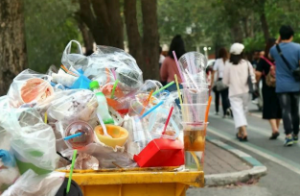
While food-service waste represents a smaller share of the total compared to households, it remains a critical leverage point for sustainable change. In Greece, where restaurant waste rates exceed the EU average, coordinated action among policymakers, industry stakeholders, and consumers is essential. Improved measurement, financial incentives for food donations, and awareness campaigns could significantly reduce losses across the hospitality chain. Aligning national efforts with EU reduction targets will not only conserve resources but also strengthen the resilience and sustainability of Europe’s food systems.
References
European Commission. (n.d.). Food waste. https://food.ec.europa.eu/safety/food-waste_en
European Parliament. (2025). Food loss and waste: What EU actions are there? https://www.europarl.europa.eu/topics/en/article/20240318STO19401/food-waste-reduction-what-eu-actions-are-there
Eurostat. (2024, September 27). Food waste: 132 kg per inhabitant in the EU in 2022. https://ec.europa.eu/eurostat/web/products-eurostat-news/w/ddn-20240927-2
Eurostat. (2025, October 16). 130 kg of food wasted per person annually in the EU. https://ec.europa.eu/eurostat/web/products-eurostat-news/w/ddn-20251016-2
Greek City Times. (2025, October 18). Greece ranks 3rd in EU with over 2 million tons of food waste. https://greekcitytimes.com/2025/10/18/greece-ranks-3rd-with-over-2-million-tons-of-food-waste/
In.gr. (2025, October 18). Food waste: Greece among EU’s top three. https://www.in.gr/2025/10/18/english-edition/food-waste-greece-top-3-eu/
Kathimerini. (2025, October 18). Greece among Europe’s food-waste champions. https://www.ekathimerini.com/economy/1284097/greece-among-europes-food-waste-champions/
En.rua.gr. (2025, October 17). Greece ranks third in the EU in terms of food waste: 201 kg per person. https://en.rua.gr/2025/10/17/greece-ranks-third-in-the-eu-in-terms-of-food-waste-201-kg-per-person/
Images
European Food Information Council. (n.d.). Food-waste-in-Europe infographic [Infographic]. https://www.eufic.org/en/media/images/Food-waste-in-EuropeSM-card.png
Tourism Tattler. (2019, November). Food waste in tourism. https://www.tourismtattler.com/wp-content/images/2019/11/Food-Waste-in-Tourism-1280×853-1.webp